

She Accidentally Built the Best AEO Content System I’ve Ever Seen. She’s a Real Estate Agent in Tucson.
A YouTube-first flywheel that turns one filming session into six structured assets — and what chiropractors (and every local practitioner) should steal from it.

Last month I published the first AEO study outside of B2B SaaS — 62 queries, 3 AI models, 2,293 citations across chiropractic care. The headline finding was the Practitioner Atomization Effect: 1,041 practice sites get cited, but they’re interchangeable. Nobody escapes the commodity pool.
Since then I’ve been thinking about what “escaping the commodity pool” actually looks like in practice. Not in theory. Not in a framework deck. What does a local practitioner doing this well actually produce?
I found my answer in Tucson real estate.
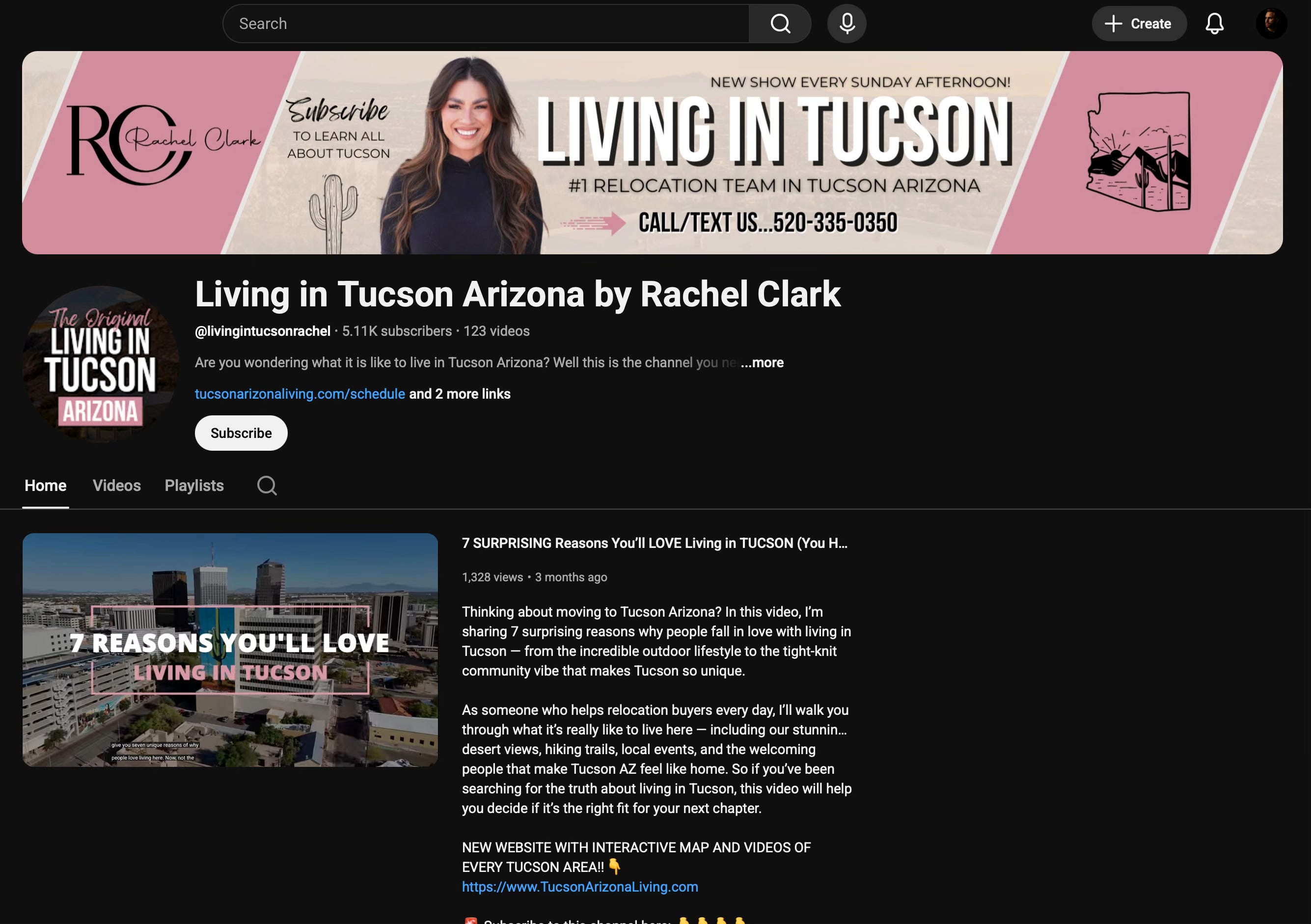
The Channel
A real estate agent in Tucson named Rachel Clark runs a YouTube channel focused on new construction communities and relocation guidance. Weekly uploads, every Sunday. Walking tours of model homes, area overviews, pros-and-cons videos about living in Tucson, builder-by-builder breakdowns with specific pricing. Her site has a Domain Rating of 0.9 and gets about 1 monthly organic visitor according to Ahrefs.
On paper, this is a site that shouldn’t matter to anyone — least of all AI models.
But when I broke down what she’s actually building, I realized she’s accidentally assembled the most AEO-ready content system I’ve encountered in any local practitioner niche. Not because she’s read Josh Grant’s playbook. Not because she’s implementing schema or running AirOps workflows. Because the shape of what she produces — the structure, the information density, the multi-surface output — maps almost perfectly onto what AI models are designed to consume.
She doesn’t know she’s doing AEO. She’s just making really good YouTube videos. And that’s exactly why it’s instructive.
The 7-Stage Script Framework
I analyzed six of her video transcripts across four content types — area overviews, community deep dives, pros/cons listicles, and builder home tours. Every video, regardless of type, follows the same structural template:
Stage 1: Hook (<15 seconds). Creates urgency and states the payoff. “Tucson has over 300 subdivisions, but only a handful are designed to make people stay, spend, and build their lives there.”
Stage 2: Authority + Subscribe. Establishes local expert credentials, prompts the subscribe, plants the first contact seed. “Hi, I’m Rachel, your born and raised local expert on all things Tucson.”
Stage 3: Content body. The core information gain. This is where things get interesting — I’ll come back to it.
Stage 4: Website showcase. Mid-video, she walks viewers through her website — interactive map, relocation guide download, scheduling tool. It’s simultaneously a CTA and a trust signal.
Stage 5: Pricing and lot data. Decision-critical specifics: base prices, lot premiums, quick move-in vs. ground-up options, current incentives. “The Cassandra starts at $654,000 to build from ground up. Lot premiums range from $25,000 to $50,000. Quick move-in out the door: $767,000.”
Stage 6: Representation CTA. Educates buyers on why they need a realtor for new construction and positions herself as free to the buyer. “I don’t work for the builder. I work for you. They compensate me, not you.”
Stage 7: Close + video chain. Soft close with contact info, end-screen link to a related video. “If you’re interested in seeing a walkthrough of that RV garage, click this link up above.”
The consistency is what matters here. Models latch onto predictable patterns. When every video follows the same 7-stage arc, and every blog post follows the same structural template, the content becomes learnable. An AI model encountering its tenth page from this site already knows where the pricing data lives, where the school information lives, where the drive-time data lives.
That’s structural consistency — one of the AEO Playbook’s core principles — achieved without a single line of schema markup.
The Information Gain Engine
Stage 3 — the content body — is where the real AEO value hides.
In a single 35-minute community deep-dive video, she covers: geographic orientation from downtown Tucson (33-minute drive via the Twin Peaks exit), room-by-room model home walkthrough with standard vs. upgrade callouts for every feature, three floor plan options with base pricing, a lot map with sold/available/unreleased status and lot premium ranges ($45K–$150K), school district breakdown with ratings, and drive-time mapping to every relevant amenity — grocery (10 min), Target (23 min), Costco (23 min), hospital (15 min), Trader Joe’s (25 min), specific restaurants by name.
One video. Fifty to a hundred unique data points.
Here’s why that matters for AEO: this is information an AI model cannot generate from training data. No LLM knows that the closest Costco to Dove Mountain is 23 minutes away, or that lot premiums on the east-facing lots run $45K–$150K, or that the Sorro Creek K-8 school just opened for the 2025 school year. Every one of those data points is information gain — the single attribute that, in the chiro study, showed a 2.45-point gap between cited and non-cited sites.
Rachel’s content is drowning in information gain. Not because she’s trying to score well on a content engineering rubric, but because she’s answering the actual questions her clients ask during consultations. She just does it on camera instead of in a car.
The Drive-Time Pattern (And Why It’s AEO Gold)
There’s a specific language pattern she uses that deserves its own section, because it’s one of the most AEO-potent structures I’ve seen in any niche.
It goes like this: “From [subdivision], [amenity] is [X] minutes away. You would [route description]. This is your [qualifier: closest/northwest/etc.] [amenity type].”
She does this 15–25 times per community video. Every amenity, every direction, every time estimate.
Why does this matter? Because it directly generates answers to long-tail AI queries: “How far is Dove Mountain from a Costco?” “What’s the closest grocery store to Rocking K?” “Is there a hospital near Oro Valley?” These are the exact queries that relocation buyers type into ChatGPT and Perplexity. Each one is a potential citation.
A single community video, converted to a blog post, creates a page that can serve as the canonical source for dozens of these micro-queries. And because the data is hyper-specific and locally sourced, no national site — no Zillow, no Redfin, no Realtor.com — can compete. They don’t have it.
This is the Webflow dynamic from the AEO Playbook at the local level. Webflow has 1.2% CMS market share but owns ~60% of AI answers in their category. A solo real estate agent with DR 0.9 is sitting on content that could produce the same outsized citation concentration — if she closes the authority gap.
The Flywheel: One Input, Six Outputs
Here’s where the real estate model becomes a blueprint.
Rachel’s workflow creates a compounding content loop from a single input:
Input: Film one video at a model home or community on a weekend.
Output 1: YouTube video. Uploaded every Sunday. SEO-optimized title. Embedded in blog post. Directly crawlable by Perplexity (which leans ~75% on YouTube and Reddit for citations, per the AEO Playbook).
Output 2: AI-generated blog post. She uses a video-to-blog tool that transcribes the video, structures it into a blog post with TL;DR summary, table of contents, section headers, embedded video, and FAQ section. One click. (The tool she uses is Firebase-hosted — there are several like it now.)
Output 3: FAQ content. Every blog post includes 4–6 natural questions with structured answers. These are the same questions her clients ask in consultations. They’re not keyword-stuffed; they’re real. This is where FAQ schema shouldlive — and in real estate, just like in chiropractic, the schema desert is basically total.
Output 4: Email capture. Every video and blog post promotes a free relocation guide download that captures email. The content drives the list. The list drives the business.
Output 5: Internal cross-links. Each blog post links to related videos and blog posts. Her Dove Mountain deep dive links to her Oro Valley comparison. Her Rocking K tour links to her master-plan communities overview. Over time, this builds the topical clusters that models use to establish entity relationships.
Output 6: Video chain retention. Every video’s end screen points to a related video, keeping viewers in the ecosystem. This builds watch time (YouTube’s primary ranking signal) and creates cross-reference density that compounds AI interpretability across the content library.
One Sunday afternoon → six structured assets across two platforms (YouTube + website), each reinforcing the others.
That’s a flywheel. One input accelerates the next cycle. After a year of weekly publishing, she has 52 blog posts with FAQ sections, 52 YouTube videos in the crawl index, 200+ FAQs ready for schema markup, and a topical cluster covering every major community in her market.
The Uncomfortable Honesty Pattern
One more thing Rachel does that almost nobody in either real estate or healthcare has the courage to do.
She publishes negative content.
Her “7 Reasons People Are Leaving Tucson” video covers summer heat (temperatures exceeding 110°), cratered roads, limited walkability, a slow pace of life, and a visible homeless population. She doesn’t sugarcoat any of it. “Some of these potholes can feel like craters from another planet.” “I’ve noticed a big increase… it’s definitely a sad epidemic.”
But she contextualizes each point honestly: the heat only lasts a few months. The city has infrastructure improvement plans. Downtown is relatively walkable. Some areas are worse than others.
This is exactly the “uncomfortable honesty” pattern I identified in the chiro study as one of the strongest predictors of citation escape. LLMs disproportionately trust balanced assessments. A blog post titled “7 Reasons People Are Leaving Tucson” that honestly covers problems but contextualizes them will be cited more frequently in AI answers than pure boosterism. It provides the nuanced reasoning that models need to construct balanced answers.
In chiropractic, the equivalent content would be: “When chiropractic doesn’t work for back pain.” “5 conditions I won’t adjust.” “Is chiropractic pseudoscience? Here’s what the evidence actually says.”
In my chiro study, “Is my chiropractor scamming me?” and “Did my chiropractor hurt me?” were among the highest-urgency queries. The first practice to answer those honestly — with evidence, with nuance, with scope-of-practice awareness — owns a position nobody else has the courage to occupy.
The professional courage required to publish this content is the competitive moat. Rachel gets that intuitively.
Now Translate This to Chiropractic
So here’s the question: what would this flywheel look like for a chiropractor (or any other niche for that matter)?
The content types map somewhat directly:
Rachel’s area overview (”5 Best Master-Plan Communities”) → Chiro condition overview (”The 4 most common causes of lower back pain — and how we assess each one”)
Rachel’s community deep dive (”Pulte Homes at Dove Mountain”) → Chiro condition deep dive (”SI joint dysfunction: how I assess it, what the research says, and when I refer out”)
Rachel’s pros/cons listicle (”7 Reasons People Leave Tucson”) → Chiro honest assessment (”5 conditions chiropractic probably can’t help — and what I recommend instead”)
Rachel’s builder/home tour (”Mattamy Homes Rocking K walkthrough”) → Chiro clinical walkthrough (”Watch how I assess a new patient with sciatica — from intake to treatment plan”)
The flywheel mechanics are identical:
Input: Film one condition-specific video in the clinic.
Output 1: YouTube video. But here’s what most chiropractors miss — the YouTube description is directly crawled by LLMs. A chiropractor who puts a structured summary in the description (Condition: X, Assessment: Y, Evidence: Z study from JMPT, When to refer: criteria A/B/C) is creating a parseable data source that Perplexity in particular picks up.
Output 2: Blog post via transcript. Same video-to-blog pipeline Rachel uses. Except the chiro version has a crucial advantage Rachel’s doesn’t: you can cite research. “A 2023 systematic review in JMPT found…” — this is the Layer 1→3 bridge I identified in the chiro study. The practitioner who drops PubMed citations in their video gets them in the transcript automatically. The blog post then bridges the science layer and the practitioner layer in a way that nobody else does.
Output 3: FAQ schema. The chiro study’s most actionable finding: zero of 31 audited sites implement FAQ schema. Zero. A chiropractor running this flywheel who adds FAQ schema to every blog post enters a game with literally no competitors.
Output 4: Structured condition pages. This is where chiro has an advantage over real estate. Rachel links her blog posts to community pages. A chiropractor links their video blog posts to condition-specific service pages — and can add MedicalCondition schema, HowTo schema for exercises, and clinical reasoning that no national site (Healthline, WebMD) can replicate.
Output 5: Email/booking capture. Every video drives to an online scheduling page. Simpler than Rachel’s multi-CTA funnel, and it should be — chiro is a lower-stakes decision than buying a house.
Output 6: Video chain. “If your sciatica isn’t improving after 4 weeks of care, watch my video on when imaging makes sense.” This builds the same topical clusters on YouTube and the blog simultaneously.
Why Video Is the Cheat Code for the Publishability Hypothesis
In the chiro study, I introduced the Publishability Hypothesis: in healthcare, the content most likely to escape citation atomization publishes clinical reasoning rather than clinical claims.
Writing clinical reasoning is hard. It requires careful framing, evidence citation, scope-of-practice awareness. Most chiropractors I’ve talked to find the blank page paralyzing — which is exactly why 1,041 practice sites default to rewriting what Healthline already said.
But here’s the thing: clinical reasoning is naturally conversational. Chiropractors explain their reasoning to patients all day long. They walk through assessments, explain why they’re choosing one approach over another, describe what they’re feeling in the spine, discuss when they’d refer to PT or ortho.
They just don’t write it down.
Video eliminates the blank page problem entirely. A chiropractor who sets up a camera and walks through their actual clinical thinking — “Here’s what I’m looking for when a patient presents with this complaint, here’s what the research says about manual therapy for this condition, here’s when I’d change course” — is producing high-information-gain content without having to write a single word.
The video-to-blog pipeline turns that clinical reasoning into structured text. The FAQ section captures the natural questions. Schema markup makes it machine-readable. And because it’s first-person practitioner voice, it carries E-E-A-T signals that commodity blog content never will.
Rachel figured this out for real estate by accident. She just turns on the camera and talks through what she knows. The pipeline does the rest.
A chiropractor can do exactly the same thing. The difference is that the chiro version bridges the three-layer trust hierarchy in a way that real estate doesn’t need to — citing the science, showing the reasoning, being honest about limitations. That’s a structural advantage, not a constraint.
The Math on Why Nobody’s Doing This
Let’s make it concrete.
A chiropractor who publishes one video per week for 6 months covers 24 conditions or topics. Each generates a structured blog post with 4–6 FAQs. That’s 24 blog posts, 24 YouTube videos, and ~120 FAQ schema entries, all cross-linked into condition pages with MedicalCondition schema.
In a vertical where zero of 31 sites implement FAQ schema.
Where Domain Rating correlates at r = 0.197 with AI citations — meaning authority barely matters.
Where information gain shows a 2.45-point gap between cited and non-cited sites — the single strongest predictor.
A chiropractor with DR 3 running this flywheel would likely out-cite a DR 40 site publishing generic content. The data from the chiro study supports that prediction directly.
The real estate case study shows it’s operationally feasible for a solo practitioner. Rachel does this alone, weekly, with a camera and a video-to-blog tool. No content team. No agency. No six-figure budget.
The AEO Playbook says the first mover in a schema desert has zero competition.
In chiropractic — and probably dentistry, PT, optometry, mental health — that first mover hasn’t shown up yet.
What’s Actually Holding This Back
It’s not technical. The tools exist. Video-to-blog converters are available. Schema markup is free. YouTube is free.
It’s not budget. Rachel’s entire content operation is one person with a camera.
It’s two things:
First, most practitioners don’t think of themselves as content creators. They think of content as marketing, and marketing as something they outsource to an agency that writes generic service pages. The mindset shift required is: your clinical expertise is the content. The camera is just the capture device.
Second — and this is the bigger one — the content that works best for AEO is the content that requires professional courage. The honest assessment of limitations. The “here’s when I’d refer you elsewhere.” The “here’s what the evidence actually shows, and it’s more nuanced than you’ve been told.” Most practitioners won’t publish that. Which is exactly why the ones who do will own the AI answer layer for their entire vertical.
Rachel’s “7 Reasons People Leave Tucson” video is, structurally, the same play as a chiropractor publishing “Is chiropractic pseudoscience? Here’s what the research actually says.” Both require saying things your competitors won’t. Both create the balanced, evidence-informed content that AI models disproportionately trust and cite.
Both are playing a game with no competitors — because the barrier to entry is courage, not budget.
The chiropractic AEO study (Phase 1) with all data tables and methodology is published here. Phase 2 — the intervention study testing whether structural changes produce measurable citation lift — is underway. Subscribe to follow the experiment.
If you run a practice and want to talk about what this flywheel looks like for your vertical, I’m reachable here.